Lo que conviene saber sobre el mundo de Squarespace.
Para diseñadores, desarrolladores y personas que crean negocios en torno a Squarespace.

Freelancer, Solopreneur, Founder, Entrepreneur — What’s the Difference?
(and why it matters if you want real freedom)
When I started freelancing, I thought all these titles were just marketing spin.
Freelancer. Solopreneur. Founder. Entrepreneur. Sure, they sounded different — but I assumed it all boiled down to the same thing: "I work for myself."
What I didn't see then is that each identity comes with its own patterns — and those patterns determine how you price, who you work with, the kind of opportunities you even notice, and how much freedom you actually have.
If you want to get off the client roller coaster, you first have to figure out where you are right now, and where you actually want to go.
The Freedom Spectrum
Think of it like a spectrum: Freelancer → Solopreneur → Founder → Entrepreneur. On the far left, you have the least leverage and the most dependency on your personal labor. On the far right, you have the most leverage and the least dependency on your time.
Your goal doesn't have to be "max leverage, no labor" — but you do need to know where you are and what each step toward the right would mean for your freedom.
Stage 1: Freelancer — Selling Time and Skills
Here you think "I do work for clients," and your freedom level is low because if you're not working, you're not earning.
Freelancers typically price based on effort like hours, days, or deliverables. They experience feast and famine cycles, say yes to whatever comes along, and find themselves being reactive instead of proactive. Freelancing can be great for getting paid quickly, but if you stay here without a plan, you're essentially an employee with multiple bosses and all the instability that comes with it.
The freedom check: How long could you step away before your income stopped?
Stage 2: Solopreneur — Owning the Business, Wearing All the Hats
Your mindset shifts to "I'm a business owner," and your freedom level becomes medium because you control more, but you're still the engine driving everything.
Here you move from "I work for clients" to "I run my own business." You start thinking about marketing, sales, and client experience, not just delivering the work. The big shift is taking a consultative approach where you see yourself as a business owner helping another business owner achieve an outcome.
Solopreneurs set processes instead of working ad hoc, build recognizable offers, and start choosing projects instead of accepting whatever shows up. The freedom check becomes: If you took a month off, would your business survive without a scramble when you got back?
Stage 3: Founder — Building Something Bigger Than Yourself
Now you think "I'm building an asset," and your freedom level is high because your income isn't fully tied to your labor.
A founder creates something that can operate without their constant involvement — a product, a platform, a team-run service. This is where you move from client work as the business to client work as one part of the business.
Founders develop documented systems, create assets that produce revenue without their daily labor, and build teams or partnerships where others own parts of the process. Your freedom check becomes: If you disappeared for 90 days, would revenue keep coming in?
Stage 4: Entrepreneur — Playing the Long Game
Your mindset becomes "I build value and turn it into more value," though your freedom level is variable depending on your focus and discipline.
An entrepreneur spots and captures opportunities, sometimes in their current business, sometimes in new ones. They think in terms of multiplying assets, not just operating them. This could mean starting, acquiring, selling, or investing in businesses.
Entrepreneurs focus on strategic partnerships and acquisitions, spread risk across multiple streams, and operate from vision rather than just daily needs. The ultimate freedom check: Do your assets generate more income than your living expenses?
How to Move Along the Spectrum
Most people don't jump straight from Freelancer to Entrepreneur. The common path involves moving from Freelancer to Solopreneur by shifting from "hired help" to consultative partner, setting up processes and choosing projects intentionally. Then you progress from Solopreneur to Founder by packaging what works into assets, hiring selectively, and reducing the need for you in every delivery. Finally, you move from Founder to Entrepreneur by decoupling income from operations and spotting scalable opportunities beyond your core business.
Why This Matters for Freedom
Freedom isn't just "working for yourself." Freedom is having assets that generate more income than your expenses, and the further you move along this spectrum, the more that becomes possible.
The biggest mistake is staying in one stage without realizing it's a stage.
Your Next Step
If you want to start stepping into bigger opportunities — the kind that require you to think and operate like a business owner, not just a service provider — you need to be in rooms where those opportunities live.
That’s why I curate the $10K Project List — weekly leads for high-value creative projects.
It’s the easiest way to start positioning yourself as a partner to other business owners, not just a pair of hands.

Why “Charge Your Worth” is Bad Pricing Advice
If you’ve been freelancing for a while, you’ve probably heard this one:
“You just need to charge what you’re worth.”
It sounds empowering. It makes you feel like you’re standing up for yourself.
But here’s the thing. It keeps you focused on you — your confidence, your insecurities, your self-esteem — instead of the real drivers of price.
If you want to get off the client roller coaster and build a business around assets that don’t depend on your time, you need a different way of looking at pricing.
Here’s what I teach the freelancers I work with 👇🏽
1. Pricing isn’t about you
“Charge your worth” turns pricing into a self-esteem exercise.
Clients aren’t buying you. They’re buying an outcome.
Your worth as a human being is infinite. The market value of your work? That’s entirely about the impact it creates for them.
When you see that clearly, pricing stops being about whether you “feel confident” and starts being about what the result is worth in their world. That’s a much more stable foundation to build on.
2. The ceiling on your price isn’t your skill — it’s the size of the budgets you’re around
If you only talk to people whose max spend is $2K, that’s all you’ll ever get offered — no matter how good you are.
High-value projects live in different rooms. The people in those rooms have different priorities, different timelines, and a different idea of what “reasonable” looks like.
I’ve seen freelancers go from $2K projects to $20K projects without changing their skillset — they just started showing up where $20K was the norm.
That’s the real “glass ceiling” in pricing, and it has nothing to do with your talent.
3. High-Budget Clients Aren’t Buying Your Time — They’re Buying Certainty
When you’re in the $10K–$50K project range, the client isn’t asking, “How many hours will this take you?”
That’s a small-budget question.
Big-budget clients are asking:
“Will this solve the problem?”
“Will this help us hit our goal?”
“Can you deliver without making it harder for us?”
They’re buying certainty — certainty that you understand the stakes, that you’ve thought through the risks, and that you can make the project happen without creating more problems than you solve.
Once they feel that from you, the hourly math disappears. If you keep pulling them back into an “hours × rate” conversation, you don’t raise their confidence — you lower it.
4. You’re not just the person doing the work — you’re a lever
When you price like a freelancer, you’re selling labor.
When you price like a business owner, you’re selling impact.
If your work helps a client generate $250K, charging $25K isn’t “expensive” — it’s a bargain.
I’ve talked to people who delivered projects in the $20K–$60K range that took the same effort as a $2K job. The difference wasn’t the workload — it was the scale of the result.
5. Bigger projects aren’t harder — they just require more trust
The leap from a $2.5K project to a $25K project is almost never about technical complexity. It’s about trust.
High-budget clients need to know:
You can handle the scope.
You’ll keep the project on track.
You won’t create new problems in the process.
That trust comes from how you show up, the process you lead them through, and the proof you can give that you’ve handled similar stakes before — or that you’ve thought far enough ahead to de-risk the project.
The real shift
When you stop trying to “charge your worth” and start charging based on value:
You stop negotiating against yourself.
You start having better conversations with better clients.
You start building a business that isn’t chained to your hours.
That’s how you get off the client roller coaster for good.
Want to see what those bigger projects actually look like?
Every week I curate a list of $10K+ web design and creative projects so you can see the kinds of opportunities where value-based pricing isn’t just possible — it’s expected.
It’s called the $10K Project List. When you start seeing these every week, you stop wondering if bigger budgets exist — you start figuring out which ones you want.
This was originally posted on the Freelance to Freedom newsletter by Omari Harebin.

5 Common Mistakes to Avoid When Customizing a Squarespace Template
Editor’s note: I see great templates turn into “DIY soup” during edits. Big Cat Creative specialize in Squarespace templates, so I asked them to break down the five mistakes that cause that—and what to do instead.
The reason you buy a template is so you can start with a design that is already good. It's supposed to look better than designing it yourself from scratch! (Right!? 😅)
But if you're not careful, and if you don't have a plan going in, your template could turn into a bit of DIY mess.
At Big Cat Creative, we've helped thousands of small businesses and creatives design stunning websites using our premium Squarespace Templates. So, we've seen it all. The beautiful, the fun, the bold, and the... well... almost-there.
Our goal is for everyone to have a website that they love and are proud of. Using a Squarespace Template is a great way to make this happen. You get to invest in professional level website design at a fraction of the cost, and you learn so much along the way.
But, if you're using a template, you're probably not a designer (that's the point!). And if you rush through the process, your websites could end up looking a bit disjointed, messy, and DIY'd (not in the fun, scrapbook way).
As a non-designer, it's hard to put your finger on just what it is that is making your site look not as put together as it should.
Luckily, usually it's only a few small tweaks that will make it all come together and look legit.
So whether you’re just shopping templates, mid-edit or almost ready to launch, we're here to give you some tips that will help you get the most out of your template, produce something that actually looks good, and feel proud of the website you built!


MISTAKE #1: Over-Customizing Until It Doesn’t Look Like Anything like the Original Template Anymore
We get it. You want your site to feel like you. And you should customize it!
But when you move every block, change every section, and swap out every layout, you lose the visual structure and conversion strategy that made the template so powerful (and beautiful) in the first place.
If you haven't bought a template yet, consider this when you're choosing:
Will this template work with the layout and structure of my content? We always recommend finding a template that aligns best with the structure that you need.
This means you'll need to go in with an idea of what you need. Make a bit of a game plan first: Map out the pages you need, then roughly what you want on those pages.
We wouldn't recommend choosing a template based on colors, fonts and images. Because these are the things that can be changed most easily. In Squarespace, changing colors and fonts across your entire site is often just a few clicks.
Changing layout structure and moving blocks however is very time consuming, and a fast track to messing up the layout of the template.
Some layout tweaks are usually needed, but you'll get to where you want to go faster, and get a way better final result, if you choose a template that doesn't need to much tweaking in the first place.
What to do if you already have a template and the layout sections aren't working?
Instead of editing the template sections, try looking around your site for sections that have already been included in the template that you can duplicate and move to where you need. This way you know the section looks good already, and it will save you time!
Really stuck on a bit of your content that just won't fit in the template? At Big Cat Creative, we offer support for this sort of thing! With our templates, you get free email support included where we can give you design and technical advice to get you un-stuck!

MISTAKE #2: Only Updating Some of Your Brand Colors
One of the easiest ways to break the cohesive, pro-level look of your site is by changing some of the template colors, but not all of them.
You may have updated the main color themes, but if any buttons, fonts, or shapes still have the template demo colors, it shows.
What to do:
Before you start customizing, make sure you have a clear brand color palette.
(Psst—Big Cat Creative templates come with built-in Canva color guides that will help you create your own color palette you can slot into the template easily!).
Then, update every area of your site to reflect it. This is usually pretty easily done within Squarespace's built-in Color Palette editor. But as you work through the design of each page, pay attention to accent colors, shapes and other on-page elements, as these still might have some of the template colors.
You'll hear us say this a lot, but, consistency is what makes a site feel professional! So if you're consistent with your color palette, it'll make a huge difference.
💡 Tip! You actually don't have to change the template color palette. If creating a color palette is overwhelming, and you dont have a custom palette for your brand yet, just keep the colors the template comes with. They already look good!

MISTAKE #3: Skipping the Final Launch Checklist
You’re “done”… but your site still has broken links, leftover demo text, or unnamed pages 😬
A lot of people get through the build, hit publish, and walk away. And we totally get it.
The build can be pretty time consuming. Even with the most beautiful template, and the best resources and support (we're pretty confident we hold that title!), building a website is a big mental load. It's rewarding, and can be really fun, but it can also be tough.
So, we see a lot of people pushing "launch" on a site that's 90% there.
And look, if that's all you have left in the tank, that's better than nothing. But if you're trying to take your site from slapped-together to showstopper, then pleaseee put the finishing touches on it!
What to do:
Run through a proper "launch checklist" before you go live. That means:
Checking for spelling mistakes
Testing every button and link
Reviewing your site on mobile and tablet
Making sure there's no demo content leftover
Adding SEO titles and descriptions
Updating your favicon
And yes—we have a full "Final Launch" checklist with tutorials on how to do ALL of this included in our templates 🤗
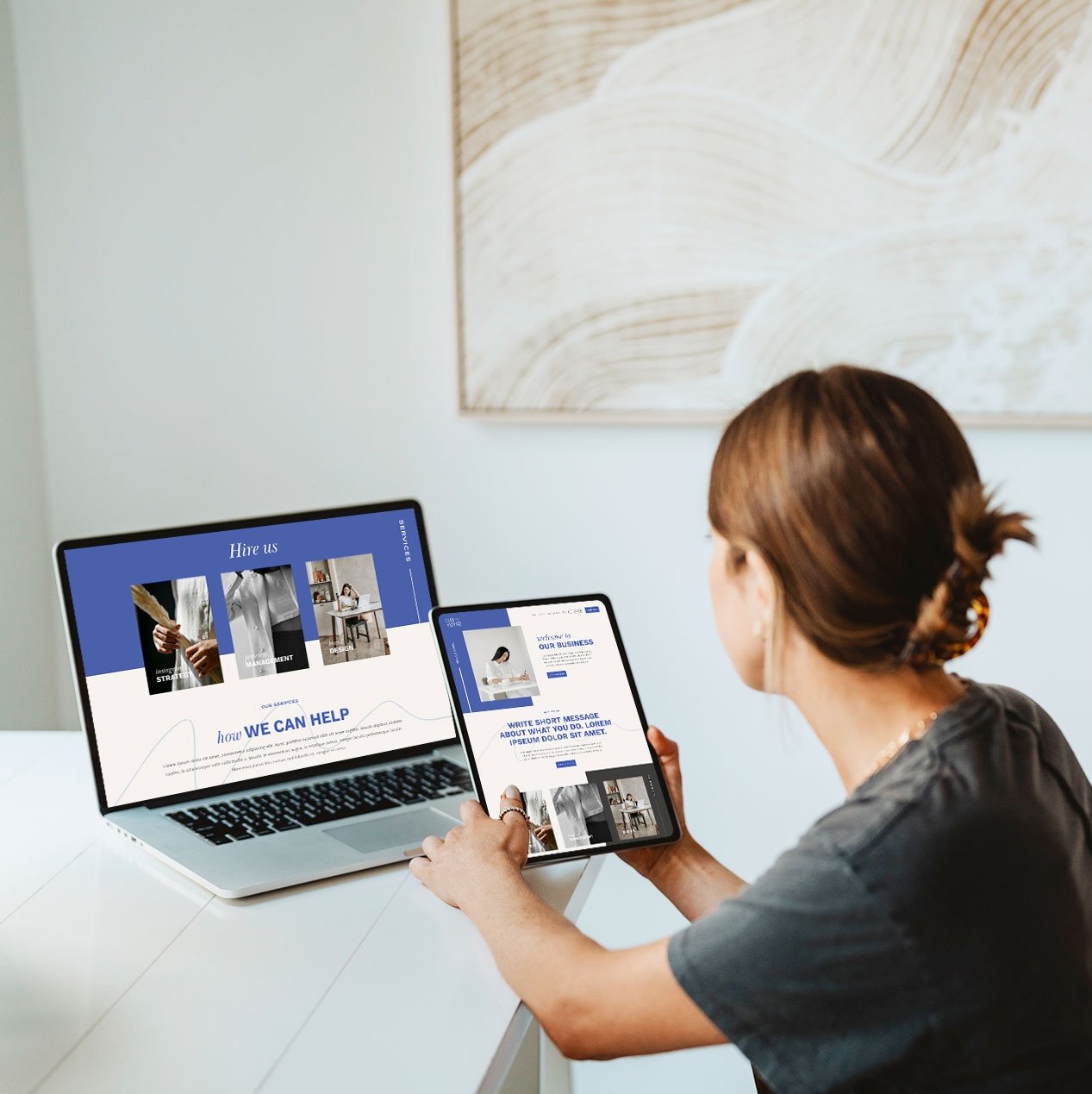
MISTAKE #4: Using Low-Quality or Inconsistent Imagery
Even the best-designed template can’t shine if your photos are doing it dirty 😩
You don’t need to hire a pro photographer (though if you can, go for it!). But you do need to be intentional about the imagery you use.
Grainy selfies, random stock photos, or a mishmash of styles can make your site feel messy and unprofessional.
What to do instead:
Choose high-quality, high-resolution photos that reflect your brand’s vibe
Stick to a consistent look and feel—consider lighting, tone, editing style, and composition
Curate visuals that match your message and connect with your dream clients
You want your images to support your design—not distract from it. Think of them as the outfit your site is wearing. If the design is the structure, the photos are what bring it to life.
Oh yeah, and, if you get a template from Big Cat Creative, we have a whole lesson on how to choose high quality, cohesive imagery, and the best places to source them from (from free to paid!).
MISTAKE #5: Choosing the Wrong Fonts
Fonts are a huge factor in the success of your web design. The right fonts will elevate your design to professional level. The wrong ones can make your whole site feel outdated or hard to read (no matter how gorgeous your layout is).
Here are some quick font rules to live by when customizing your site:
Avoid overly decorative or trendy fonts for headings. Script fonts, hand-written styles, and super stylized type can be hard to read and often look amateur when overused. It can be great in small amounts as design elements, rather than text that actually needs to be read.
Go with something more timeless. Fonts go in and out of fashion as fast as skinny jeans. To avoid looking outdated, go with a more timeless and less trendy type. The most expensive-looking sites often use the simplest fonts.
Avoid mixing too many font styles. One for headings and one for body text is usually enough.
💡 And as always, if you don’t have established brand fonts, feel free to just stick with the template’s original font pairing. It's yours to use, and it was chosen for a reason (because it looks goooood 💅).
So, how do you build a site that actually looks great?
There's no better feeling than being proud and excited to share you site. Putting yourself out there is hard! Having a beautiful site makes it SO much easier.
And we really believe that using a premium Squarespace template is one of the smartest moves you can make as a solopreneur.
It will save you so much money on custom design fees, you'll learn SO much through the process, and you really can create something beautiful.
But, it's important to avoid these common mistakes to help you keep the pro-level polish and bring your unique brand personality to the forefront.
Remember: you don’t need to be a designer to have a beautiful, strategic website—you just need the right tools, guidance and a bit of DIY spirit ✨
Big Cat Creative Squarespace templates come packed with designer-curated fonts, cohesive color guides, image inspo, a final launch checklist, step-by-step tutorials and 1:1 support—everything you need to launch a high-converting site you actually love.
We want you to be proud of your website, and the fact that you built it!
297